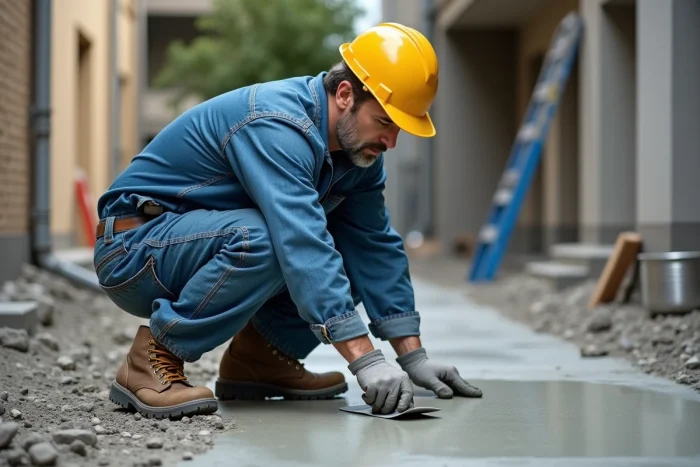
The bond between two layers of concrete never happens spontaneously. Fresh concrete placed on an old slab risks delaminating, cracking, or showing structural weaknesses if certain steps are neglected. Even after thorough cleaning, mere overlaying is not enough to ensure the strength of the whole.
Some additives or surface treatments, although commonly used, can harm adhesion if poorly chosen. The success of the operation relies on rigorous preparation and the precise application of techniques validated by professional practice.
Understanding the stakes: why pouring concrete on an existing slab requires rigor and method
The structure of a concrete slab tolerates no approximation. Placing new concrete on an old support is not taken lightly: each step affects the durability of the project and the strength of the whole. It is impossible to overlook the condition of the existing slab: cracks, surface defects, absence or poor condition of expansion joints… Everything matters, and every negligence will eventually have consequences. Without serious analysis, the new layer can quickly become weakened, jeopardizing the safety of the structure.
Working on an already poured slab means accepting a technical challenge. Pouring concrete on existing concrete requires impeccable method, based on a precise diagnosis of the condition of the concrete slab. Before starting, one must check the homogeneity of the support, identify weaknesses, assess the flatness of the surface, and inspect the joints. This observational work limits unpleasant surprises: lifting, cracking, detachment of the new slab, which can occur much sooner than expected.
What matters most is the compatibility of materials and the proper management of mechanical stresses. A poorly prepared support weakens the strength of the concrete and compromises the new slab’s ability to bear the intended loads. From cleaning to the creation of new expansion joints, every phase is crucial to ensure the longevity of the structure. For detailed advice, the resource “pouring concrete on existing concrete: techniques and advice – Déco Factory” is full of useful information.
Here are the checkpoints not to be overlooked during preparation:
- Analysis of the flatness and condition of the existing slab
- Control and adaptation of expansion joints
- Verification of material compatibility (cement, sand, water)
- Adherence to each key step to ensure safety and durability
What diagnostics and preparations are essential before intervening on an old concrete slab?
Before starting, a thorough diagnosis of the existing concrete surface is essential. Examine the slab from all angles: cracks, even minor ones, as well as signs of moisture, can seriously complicate the adhesion of the new concrete. When the concrete slab shows cracks, they must be treated: a repair mortar or an appropriate epoxy resin effectively addresses the issue. Without this precaution, the solidity of the future slab remains uncertain.
Preparation does not stop at repair. To ensure a lasting bond, the surface must be carefully prepared: degrease, remove any laitance, dust off, and sand if necessary to achieve the desired roughness. An application of bonding primer on a clean support is crucial for the success of the pouring.
A point of vigilance: the condition and continuity of the expansion joints. It is essential to ensure that they are present and extended into the new layer of concrete; otherwise, the risk of cracking significantly increases.
To summarize the essential steps of this preparation:
- Identification and repair of cracks: mortar or epoxy resin
- Cleaning, degreasing, sanding of the surface
- Application of a bonding primer
- Control and extension of expansion joints
Nothing replaces careful preparation: it is this requirement that determines the success of the project.

Practical tips to ensure adhesion, strength, and address cracks when pouring on existing concrete
<pPouring new concrete on an existing slab requires method and vigilance, step by step. Prepare the surface the day before: moisten it moderately, without excess, to prevent the support from absorbing the fresh concrete's water too quickly. This measure limits shrinkage and promotes the adhesion of the two layers.
Before laying, install a suitable welded mesh according to the thickness of the concrete. This reinforcement is your assurance against cracks and weaknesses, especially in already weakened or repaired areas. If in doubt, position the mesh to precisely cover sensitive areas.
The choice of product is not made lightly. Depending on the use of the slab, opt for ready-mixed concrete, high-strength concrete, or, for difficult access, self-leveling concrete that facilitates implementation. This detail can save valuable time on a constrained site.
During implementation, use a vibrating screed and a trowel to achieve a flat and well-compacted surface. Don’t forget to protect the slab at the end of the project: regular watering and laying a tarp slow down drying, which limits the appearance of surface cracks and maximizes the strength of the concrete.
Final instruction: respect the drying time. Any premature stress weakens the slab and can ruin hours of meticulous work. It is the attention to every detail that guarantees the durability and stability of the structure for a long time to come.