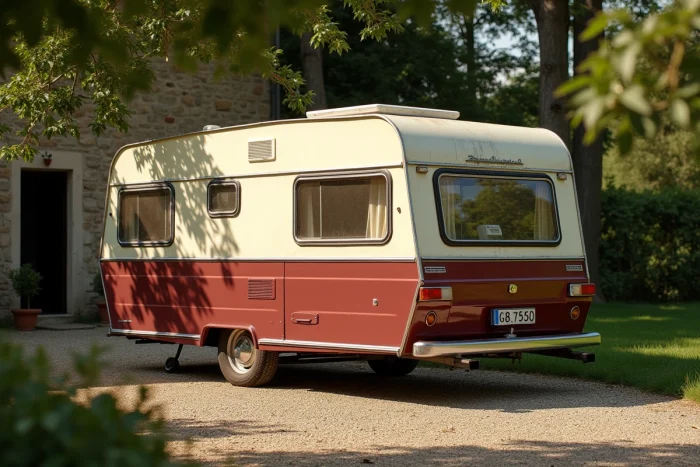
The Rubis caravan has been traveling the French roads for decades, but its manufacturer remains unclear to many potential buyers. Absent from general catalogs and rarely mentioned in specialized press comparisons, this brand maintains a discretion that contrasts with its regular presence in the second-hand market. Understanding who is behind Rubis requires tracing back to an industrial group in France whose galaxy of brands sometimes obscures the reading.
Rubis and the Trigano Group: a discreet but verifiable lineage
Administrative and commercial traces converge towards the same actor: Rubis is a brand integrated into the Trigano group. Trigano’s institutional website explicitly references it in its caravan activities, alongside more well-known names like Caravelair or Sterckeman.
This lineage is not anecdotal. Trigano is the leading European group in recreational vehicles, publicly traded, with a portfolio of brands covering motorhomes, caravans, and mobile homes. Rubis does not occupy the same place as the flagship brands of the group. It operates as a range positioned in a specific niche, with its own identity and a distinct distribution network.
For those who want to know everything about the Rubis caravan, Trigano’s official page confirms this affiliation in several languages, a sign that the brand transcends the strictly French framework.
Rubis distribution network: why you can’t find it everywhere
One of the elements that makes Rubis difficult to pinpoint lies in its marketing mode. While Caravelair or Sterckeman rely on a national network of dealers, Rubis operates through exclusive regional dealerships. Fabre-Caravanes, for example, presents itself as the exclusive dealer for the areas of Carcassonne, Toulouse, Tarn, and Ariège.
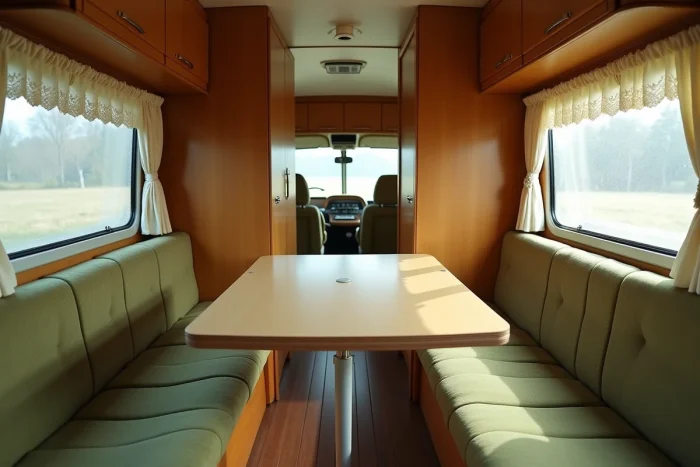
This territorial distribution model explains several things at once:
- The absence of Rubis in major national fairs or comparisons in mainstream magazines, which favor brands with wide distribution
- The difficulty in obtaining standardized information on prices or available configurations, as each dealer manages their own stock and offers
- The feeling of rarity surrounding the brand, even though new models are indeed produced and delivered each year
This distribution choice is not a sign of fragility. It corresponds to a strategy of upgrading where direct contact with a specialized network replaces volume. Rubis buyers go through a dedicated contact, which facilitates customization but complicates remote comparison.
Recent Rubis caravan collection: what current models reveal
The most recent Rubis models, visible at exclusive dealers, show a significant aesthetic evolution. Flush windows, black strips, and contemporary lighting signatures bring Rubis closer to the visual codes of the high-end motorhomes of the Trigano group.
This repositioning is not limited to the bodywork. The Rubis 495 M model, referenced in the 2026 collection, is described as “fully electric” with a shower, water heater, gas heating, blinds, and mosquito nets on all windows, slatted bed base, white aluminum wheels, and a fully polyester body (roof and sides). The specification also mentions a redesigned bumper and an integrated spare wheel.
This technical description deserves attention. The fully polyester roof and sides distinguish Rubis from many entry-level caravans that still use sandwich panels with aluminum cladding. Polyester offers better resistance to impacts and hail, a significant argument for users who park outdoors all year round.
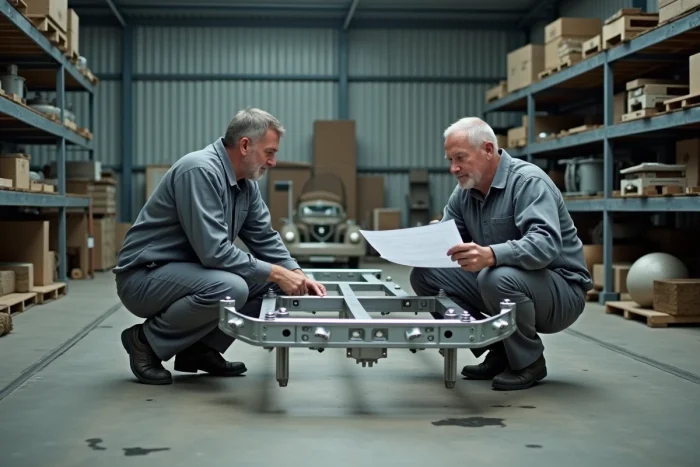
The current range includes several lengths, from the Rubis 310 to the 495 M, including the 395, 410, and 420. This diversity of sizes allows covering uses ranging from couples to family travel, without straying from the premium positioning that characterizes the brand.
Rubis in the second-hand market: what complicates identification
On classified ad sites, Rubis caravans regularly appear but do not always clearly carry the Trigano mention. Owners themselves sometimes ignore the exact lineage of their vehicle, leading to incomplete listings or erroneous attributions.
Several factors contribute to this confusion:
- The manufacturer plates on older models do not systematically mention the Trigano group, but only the name Rubis
- The original documentation (maintenance logs, manuals) has often disappeared on models over ten years old
- Some non-specialized resellers classify Rubis as an independent brand, due to a lack of knowledge about the group’s structure
For a second-hand buyer, checking the compatibility of spare parts with the Trigano network remains the most reliable way to confirm the origin of an older Rubis. Chassis elements, windows, and interior accessories often share common references with other brands in the group.
Rubis positioning within the Trigano galaxy: niche brand or premium range
Rubis is neither a confidential brand destined to disappear nor a mass-produced product. Its positioning within Trigano follows a segmentation logic that the group applies to its entire portfolio. Each brand targets a specific buyer profile, budget, and usage.
The fact that Trigano presents Rubis on a multilingual interface (French, English, German) indicates an ambition that goes beyond the French market. Field feedback varies on this point: some dealers mention a predominantly national clientele, while others mention deliveries to Benelux or Spain.
Rubis occupies a niche where living comfort takes precedence over lightness. Official descriptions emphasize that these caravans are “habitable all year round,” with a level of finish (optimized lighting, refined ambiance) that targets both sedentary users and travelers. This positioning brings it closer to a compact mobile home than to a classic touring caravan.
The Rubis brand remains a singular object in the French landscape of recreational vehicles. Produced by the leading European group in the sector but distributed like an artisanal product, it illustrates a strategy where commercial discretion is part of the positioning. For buyers, the key remains to go through the network of exclusive dealers, the only channel guaranteeing access to recent models and technical support consistent with Trigano standards.