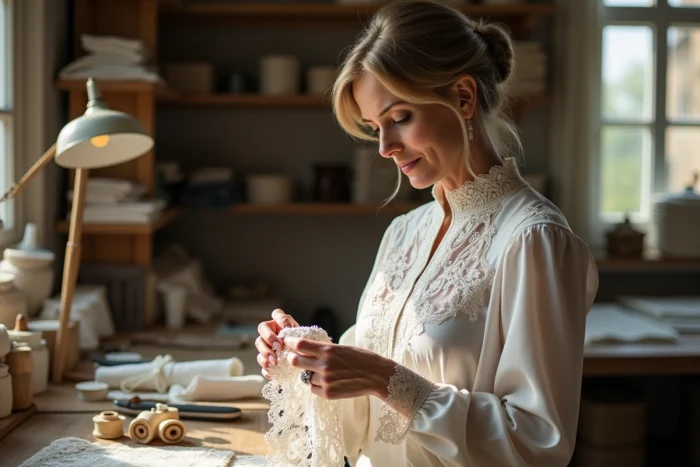
In 1665, Colbert imposed that France produce its own lace to compete with Belgium and Italy, disrupting the local economy and the customs of the aristocracy. Despite occasional bans or severe taxes, the circulation of patterns escapes the control of the authorities, leading to the creation of hybrid styles.
Techniques initially reserved for a few regions become, over time, subjects of study, exhibitions, and collective practices. Today, some museums claim unique collections, while workshops share know-how passed down beyond traditional borders.
The fascinating history of lace: from origins to the present day
The history of lace reads like a challenge to monotony, a patient advance where virtuosity is expressed in filigree. From the end of the Middle Ages, Europe sees the emergence of works signed by discreet hands, laying the first stone of an exceptional textile heritage. Quickly, northern France occupies a prime position: Calais and Caudry become the living temples of tradition, supported by the ingenuity of Leavers’ machines. These machines, true industrial feats, transform thread into refined patterns, offering creators a noble material, imbued with local spirit.
From the 17th century to the post-war period, lace accompanies social upheavals and the transformation of clothing. Variations multiply: Alençon needle lace, bobbin lace, pieces of delicacy that mark each era with a unique imprint. After World War II, Calais-Caudry lace conquers international runways, becoming synonymous with refinement and a craftsmanship that is never stagnant.
Through generations, the art of thread is passed down in the discretion of workshops. The platform madame-dentelle.fr offers an informative overview of different types of lace, revealing the richness of regions like Calais, Caudry, or Alençon. The boundaries between technique and creativity blur to give birth to a living heritage, a testament to the inventiveness of the men and women who have nurtured it.
What secrets lie behind the techniques and styles of lace?
The making of lace relies on a technical repertoire of unsuspected breadth, carefully passed down through generations. Lace makers, often in the shadows, perpetuate precise gestures, the result of long habit and constant attention. With each stitch, each intertwining of threads, the subtlety of touch is added, the meticulous adjustment of tension, the adaptation to the nature of cotton, linen, or silk.
To better understand this abundance, it is useful to distinguish the major families, according to their process:
- Bobbin lace: emblematic of the regions of Calais or Puy-en-Velay, it mobilizes a multitude of bobbins to form, thread by thread, geometric or floral designs.
- Needle lace: a tradition of Alençon or Burano, it relies on patient work stitch by stitch, where the needle draws remarkably fine arabesques.
- Mechanical lace: heir to the Leavers’ machines, it faithfully reproduces manual gestures while retaining a degree of uniqueness in each piece.
The patterns, in turn, vary according to eras and influences. Some tell the story of fashion, while others testify to a know-how passed down in secret. The workshops, jealous of their identity, cultivate their recipes, adjust the density of weaving, and explore new associations between tradition and textile innovations. Today, contemporary lace is no longer afraid to shake things up: it embraces unexpected materials, plays with contrasts to meet the demands of haute couture or independent creators.
Composing a piece of lace remains an exercise in rigor and imagination, where each pattern, each border, concentrates hours of research and repeated gestures. Behind the apparent lightness lies a rigorous discipline, driven by the desire to achieve that flexibility and delicacy prized by both professionals and admirers of rare pieces.
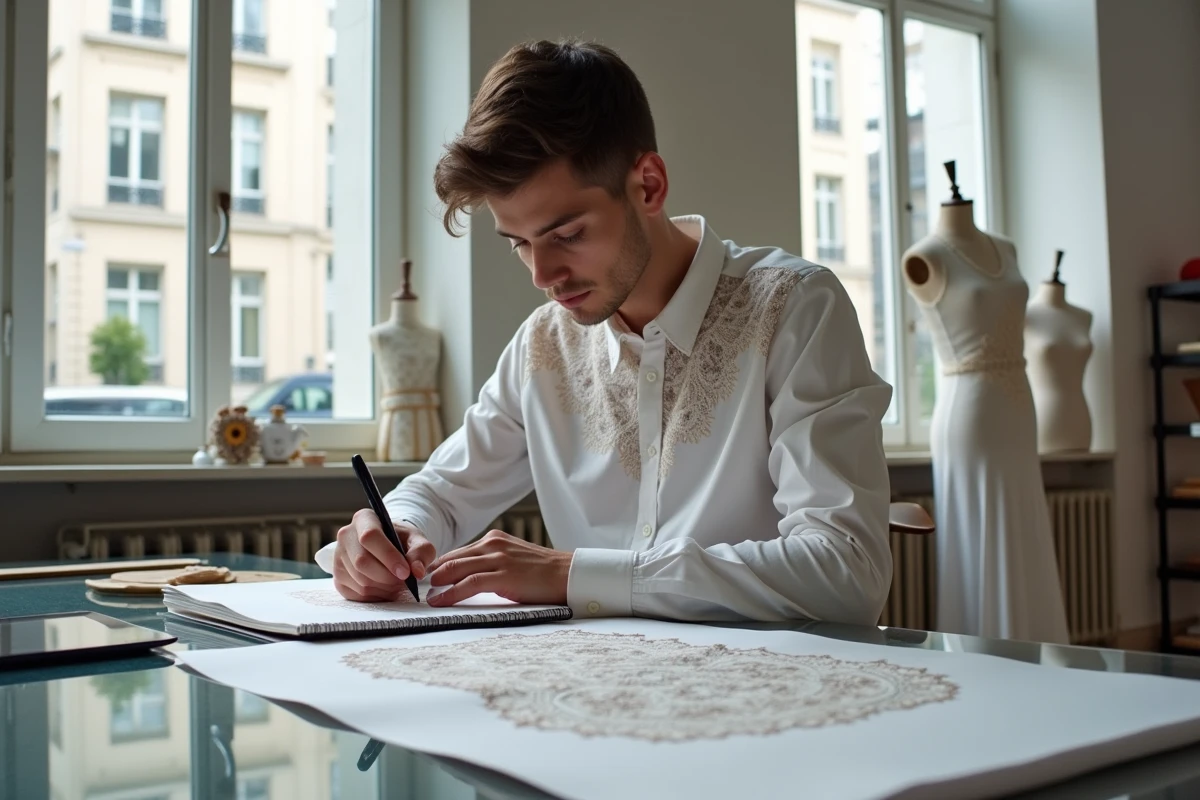
Museums, workshops, and DIY inspirations: where to fully experience the passion for lace
At the heart of museums, lace reveals all its subtlety. The lace museum of Puy-en-Velay stands as an essential stop. This place, steeped in history, highlights the gestures of lace makers, the diversity of patterns, and the transformation of techniques over time. The visit continues in the workshops, where the bobbin lace machine comes to life, revealing the magic of cotton and the delicacy of silk under expert hands.
In the streets of Puy-en-Velay, shops perpetuate the heritage while embracing today’s boldness. Lace makes its way into fashion, appears on accessories, and infiltrates decoration. Temporary exhibitions, private collections, or public demonstrations: all opportunities to marvel and inspire the imagination of those who wish to embark on the adventure of textile creation.
For DIY enthusiasts, lace becomes a privileged field of application. Kits, introductory workshops, and meetings with artisans offer a space where gestures are transmitted, tested, and renewed. Social networks are filled with tutorials, feedback, and unique creations, fueling a dynamic and inventive community.
From museum to workshop, from thread to needle, lace continues its journey. It invites one to embrace a heritage, to draw from noble materials and local stories, to reinvent the art of thread so that each creation, each experience, becomes a reflection of a time shared between memory and modernity. Tomorrow, who will dare to weave their own pattern into this endless fabric?