
No one has ever seen a productivity curve rise on its own with the help of automation. In some sites, simply stacking robots no longer impresses anyone. Today, real advancements occur at the intersection of technical innovations and method overhauls. New intelligent devices orchestrate production in real-time, capable of adjusting the pace minute by minute according to the flow of orders. We no longer speak of optimization in the classical sense: the entire industrial balance is shifting, reinvented by data and adaptability.
With artificial intelligence injected into daily management, anomaly detection no longer waits for the next breakdown. Industrial managers are accelerating the transition to predictive maintenance, tracking incidents before they become costly. This technological shift pushes decision-makers to reassess their priorities: the goal is to achieve a high level of efficiency while maintaining team flexibility, and without ever compromising on quality.
Why industrial performance today depends on technical innovation
Industrial performance is no longer solely fueled by economies of scale or maximum utilization of tools. It now relies on a permanent innovation process, which structures both production and management practices. The most efficient companies rethink their process management through digital transformation, integration of new technologies, and continuous evolution of internal practices.
In this new landscape, industrial innovation is not just a hollow slogan: it becomes a strategic lever to anticipate market variations, limit waste, adapt production to demand, and offer tailored solutions. The most responsive companies know how to leverage real-time data, manage solid indicators, and deploy digital tools designed for the reality of their sites.
Operational excellence is built step by step, optimizing each segment of the production process. Companies that succeed adopt a cross-functional approach: they focus on continuous improvement, invest in training, and embrace innovations such as EI&A. Behind these initials lies more than just a technology: it is a whole framework for measuring project success, as detailed in the file “How to Measure the Success of Your EI&A Project? – 225 Business.”
In the face of these challenges, the industry must shorten its cycles, integrate the circular economy, and create bridges between professions. Here are the key areas that now need to evolve industrial performance:
- Process optimization
- Product personalization
- Development of new working methods
These transformations are shaping a new face of industrial performance and questioning traditional competitiveness benchmarks.
Artificial intelligence, automation, data: how these levers transform performance strategies
Artificial intelligence is emerging as the centerpiece of a silent revolution. It reshuffles the cards, redefines the value chain, and gives a new impetus to production management. Thanks to predictive analysis, anticipation takes precedence over reaction: predictive maintenance becomes part of daily life, with connected sensors and algorithms capable of identifying the slightest signals indicating a breakdown. Unexpected stoppages decrease, costs contract, and the supply chain gains robustness.
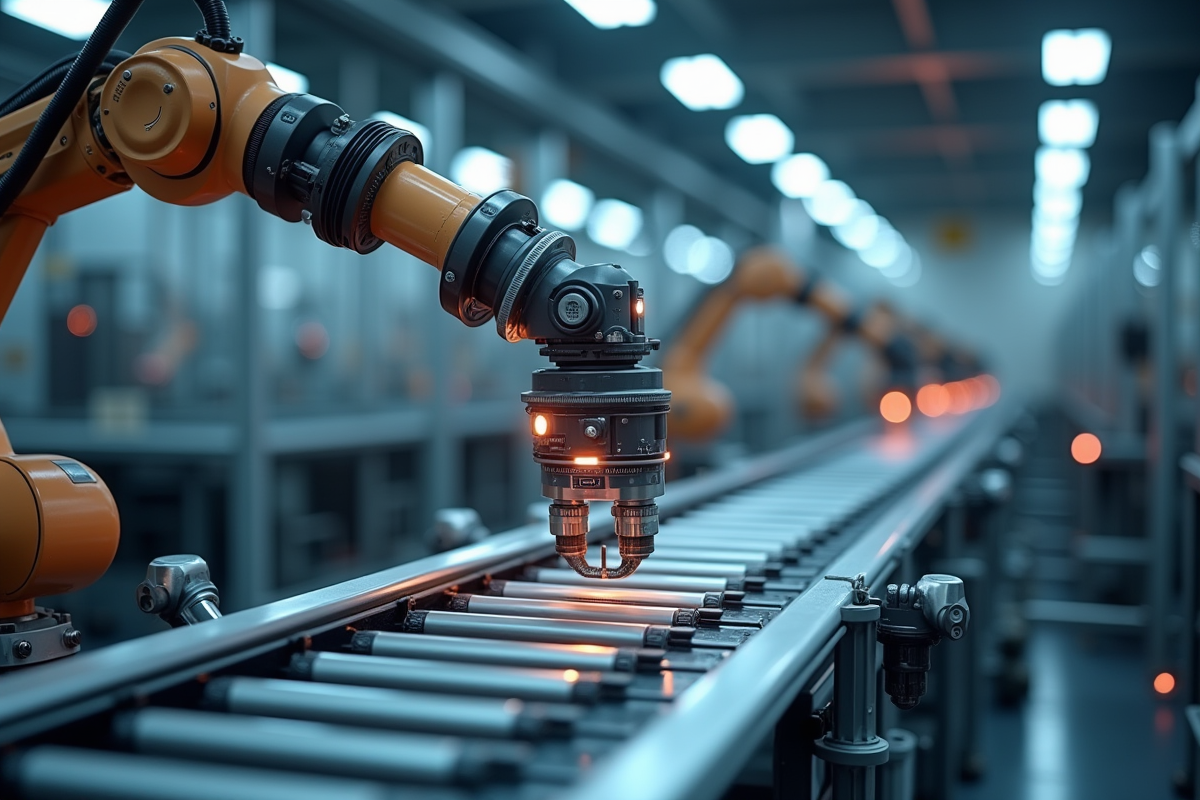
Automation is no longer limited to repetitive tasks. Collaborative robots and cyber-physical systems make production lines more flexible. The Internet of Things (IoT) paves the way for real-time supervision, accelerating decision-making and refining performance indicators. The result: responsiveness improves, management becomes more agile, and the entire industrial setup proves to be much more resilient.
Data flows at all levels, becoming the foundation of this transformation. Additive manufacturing or augmented reality offer unprecedented tools to accelerate decision-making and dare to explore options long considered out of reach.
The concrete benefits of this transformation are manifested through several axes:
- Reduction of operational costs through fine optimization of processes
- Decrease in carbon footprint thanks to rational resource management and the adoption of new models
- Increased product personalization, made possible by in-depth analysis of customer data
This trio—artificial intelligence, automation, data—now shapes industrial strategies. Performance no longer just progresses: it reinvents itself, imposing a pace that few companies can afford to ignore. The question remains who will truly seize the opportunity, and who will watch the train pass while trying to catch up with the digital wagon.