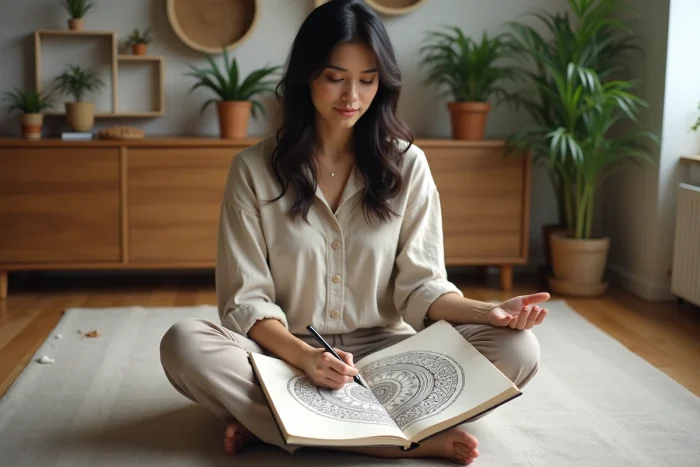
Energy drawing is distinguished from classical artistic practices by a particularity: it does not aim for technique or aesthetic result, but rather the circulation of energies in the body during the act of drawing. This approach, recently integrated into public health recommendations in France via a ministerial decree dated January 12, 2026, is gaining visibility among diverse audiences.
What do we actually measure when comparing energy drawing to other wellness methods, and what concrete results are observed in regular practitioners?
Energy Drawing and Mindfulness Meditation: Engagement and Compared Results
The comparison between energy drawing and meditation often arises among those seeking daily balance. An evaluation report of the “Creativity and Well-Being” program, published by the Workplace Well-Being Observatory (OBET) in February 2026, provides factual insights based on pilot workshops conducted in companies.
| Criterion | Energy Drawing | Mindfulness Meditation |
|---|---|---|
| Creative Engagement (hyperactive profiles) | Higher according to OBET | Lower for these profiles |
| Accessibility (required materials) | Paper, pencils, pastels | No materials required |
| Tangible trace post-session | Yes (drawing retained) | No |
| Reduction of anxiety symptoms (after 3 months) | Marked (IFI study, April 2026) | Documented but variable |
| Format suitable for hybrid remote work | Yes, short workshops possible | Yes |
The OBET report highlights that energy drawing surpasses meditation for hyperactive profiles in terms of creative engagement. The physical trace left by drawing (a medium that can be reread, compared, and preserved) provides an anchor that meditation does not offer.
To learn everything about energy drawing, one must first understand that the practice relies less on artistic talent and more on an intention set before each session: to release tension, explore an emotion, or simply let the hand translate an inner state.
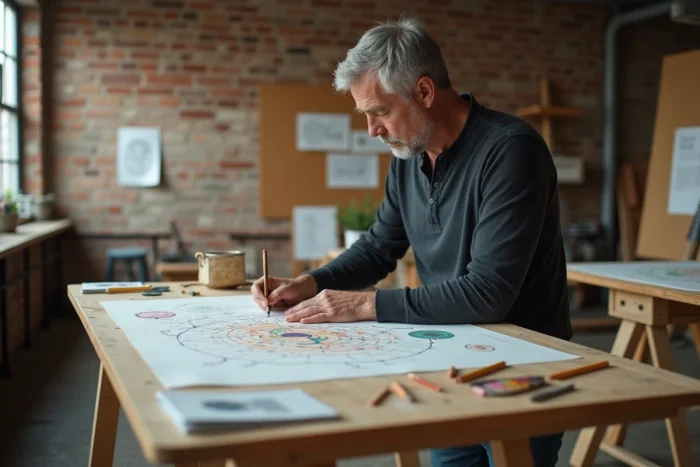
Transgenerational Blockages and Energy Drawing: The Psycho-Genealogical Dimension
Purely relaxing approaches to drawing (zentangle, meditative coloring) focus on immediate relaxation. Energy drawing goes further by posing a rarely addressed working hypothesis: some energetic blockages may be inherited from the family system.
This psycho-genealogical dimension relies on a precise protocol. The practitioner chooses an intention related to a family memory (an unresolved grief, a repetitive pattern, a transmitted fear). The graphic gesture, guided by radiesthesia or body feeling exercises, allows for the materialization on paper of tensions that have never been verbalized.
What the line reveals about family heritage
The drawing produced in this context does not resemble a figurative work. It often takes the form of spirals, broken lines, or areas of dense color. Several energy drawing teachers report that participants spontaneously identify connections between their lines and family events they were not aware of before the session.
The graphic trace acts as a revealer of bodily memories that words alone struggle to reach. This approach requires a structured framework: support from a practitioner trained in energy psycho-genealogy is recommended to avoid reopening wounds without healing them.
- Set a precise intention before drawing, related to an identified family pattern (fear, anger, feeling of abandonment).
- Use colors chosen intuitively rather than imposed, to let the body guide the gesture.
- Keep each dated drawing to track the evolution of lines over several weeks.
- Plan a time for speaking or writing after each session to anchor what has emerged.
Observed Effects on Anxiety After Three Months of Regular Practice
The French Institute of Integrative Art Therapy (IFI) published a qualitative study in April 2026 focusing on regular practitioners of energy drawing. The results pertain to professionals exposed to hybrid remote work, a context where partial isolation generates specific forms of tension.
A marked reduction in anxiety symptoms was observed after three months of practice, according to feedback collected by the IFI. The teachers interviewed for this study report that the clearest effects appear in individuals who practice at least two short sessions per week, rather than one long monthly session.
Frequency and Format of Daily Practice
Integrating energy drawing into a daily routine does not require reorganizing one’s schedule. A session of ten to fifteen minutes is sufficient to set an intention, produce a line, and observe what emerges.
The short format presents a specific advantage for personal development: it maintains a regular link between the body and graphic expression without turning the practice into a constraint. The benefits documented by the IFI specifically concern this regularity, not the duration of the sessions.

Official Recognition and Regulatory Framework in France
Since January 2026, a decree published in the Official Journal of the French Republic includes energy drawing among the non-drug complementary practices recommended for managing post-traumatic stress. This recognition changes the game for practitioners wishing to offer workshops in an institutional setting (hospitals, care centers, companies).
This regulatory evolution clearly distinguishes energy drawing from creative leisure practices. It imposes a training framework for facilitators and opens the way for better visibility for individuals seeking a validated complementary method by health authorities.
Energy drawing thus positions itself at the intersection of art therapy, psycho-genealogy, and energy healing. Its official recognition in France gives it a status that few complementary practices have achieved. For those seeking an approach that combines creativity, balance, and exploration of bodily memories, recent data points to a practice whose effects go beyond simple relaxation.