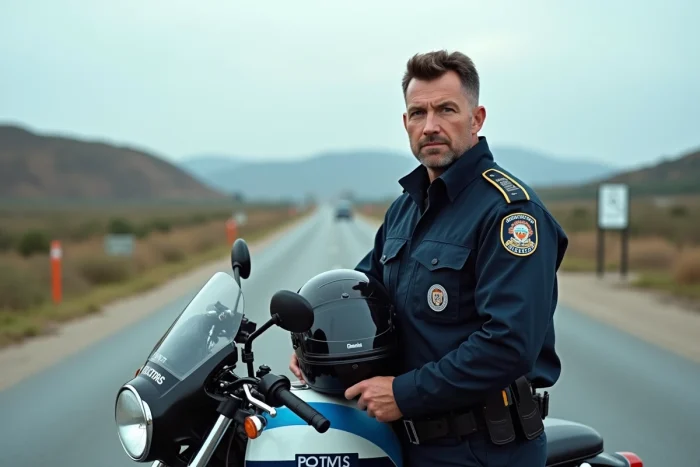
On the ground, a customs motorcyclist does not just ride fast. They check vehicles, issue fines for tax violations, and sometimes operate at night, alone, on secondary roads. To reach this point, the path combines an administrative competition, an assignment in a surveillance unit, and then a demanding internal selection process in terms of physical and medical requirements.
When coming from the motorcycle world without knowing customs culture, each step presents constraints that one might not necessarily anticipate.
Medical fitness and physical condition: filters that motorcyclists underestimate
It is often thought that knowing how to ride a motorcycle is enough. The reality of recruitment places physical condition and medical fitness well ahead of riding technique in the order of obstacles.
The administration requires a complete medical fitness validated by an approved doctor. Vision, hearing, cardio-respiratory capacity, absence of pathologies incompatible with wearing heavy equipment for several hours: everything is scrutinized. A vision correction that is too strong or a chronic joint problem can close the door even before the physical tests.
The physical tests assess endurance, resilience, and the ability to withstand repeated efforts. Working outdoors, sometimes at night, in all weather conditions, imposes a level of fitness that recreational motorcycle riding does not maintain. Those considering becoming a customs motorcyclist with Auto Tech will find useful references on the physical prerequisites to anticipate well in advance of the competition.
The key point to remember: medical fitness also conditions retention in the role. A motorcyclist in position who no longer meets health requirements may be reassigned. This is not a one-time filter; it is a permanent constraint.
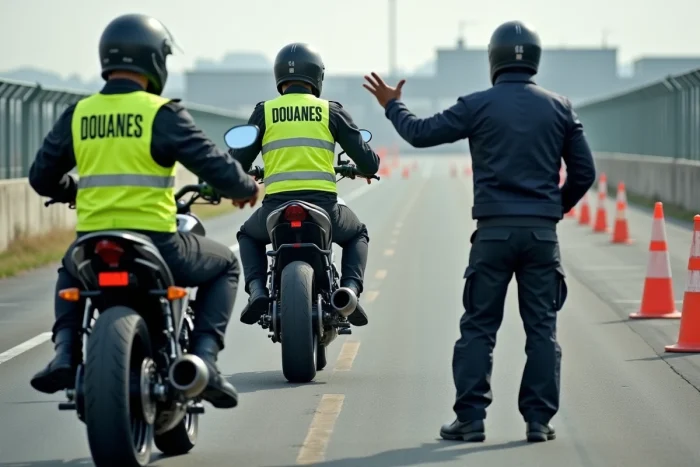
DGDDI competition and assignment in the surveillance branch
You do not apply directly for the motorcyclist position. The path first goes through a competition of the General Directorate of Customs and Indirect Rights, in category B or C depending on the targeted level.
Customs officer or customs controller competition
There are two main paths. The customs officer competition (category C) remains the most common entry point into the motorcyclist specialty. The customs controller competition (category B) also opens access to the surveillance branch, with more demanding tests in terms of legal and tax knowledge.
In both cases, the tests include:
- Written tests on general knowledge, law, or taxation depending on the category, with an expected level that exceeds simple multiple-choice questions
- A motivation interview before a jury, where concrete knowledge of customs missions weighs heavily
- Physical tests and, for the surveillance specialty, psychotechnical tests designed to assess the ability to manage operational stress
Candidates who discover the customs world while preparing for the competition should familiarize themselves with regulatory vocabulary. Knowing how to explain the difference between a first and second circle control, or understanding the legal framework of the right to visit, provides a clear advantage in the oral exam.
Assignment to a unit before motorcycle specialization
The motorcyclist specialization only comes after a period in a classic surveillance unit. You start on foot or in a vehicle, learn control procedures, write reports, and work in teams during the day and night. This phase is a necessary step, even for an experienced motorcyclist.
The duration of this step varies depending on assignments and service needs. Feedback on this point varies, but counting several months in a unit before being able to apply for motorcycle training is a realistic estimate.
Customs motorcyclist training: what happens after selection
Once selected for specialization, the customs officer joins a training center. The most well-known school is in La Rochelle, affiliated with the National School of Customs Brigades.
The training is not limited to riding. It combines three distinct blocks:
- Motorcycle riding in operational conditions: slow maneuvers, technical courses, fast riding on open roads, riding in degraded conditions (rain, night)
- Road safety applied to interventions: positioning on the roadway, vehicle interception, risk management during roadside checks
- The operational customs basics: control procedures in the field, identification of suspicious goods, drafting administrative documents in a mobile context
This last aspect distinguishes customs training from an advanced riding course. We train a versatile agent, not a demonstration rider. The motorcyclist must be able to conduct a complete check, alone, after intercepting a vehicle.
Preparing for the internal selection when you are a civilian motorcyclist
A civilian motorcyclist who masters their machine has a technical advantage but several blind spots to fill. The first is cultural: understanding how a surveillance unit operates and the hierarchical framework of the DGDDI requires personal investment even before taking the competition.
The second blind spot concerns preparation for written tests. Customs taxation, trade law, and the missions of the French customs are not part of the usual background of a motorcycle enthusiast. Working through past papers from the customs officer or customs controller competitions helps calibrate the expected level.
The third point, often overlooked, relates to physical endurance off the motorcycle. The tests do not measure the ability to stay on a saddle, but the resistance to pure cardio and muscular effort. A running, core strengthening, and upper body strengthening program prepares better than a series of turns on a circuit.
The job of customs motorcyclist remains accessible to about 250 agents across the territory, making it a rare and selective specialty. Each position is earned through a path where administrative rigor counts as much as the twist of the wrist on the throttle.