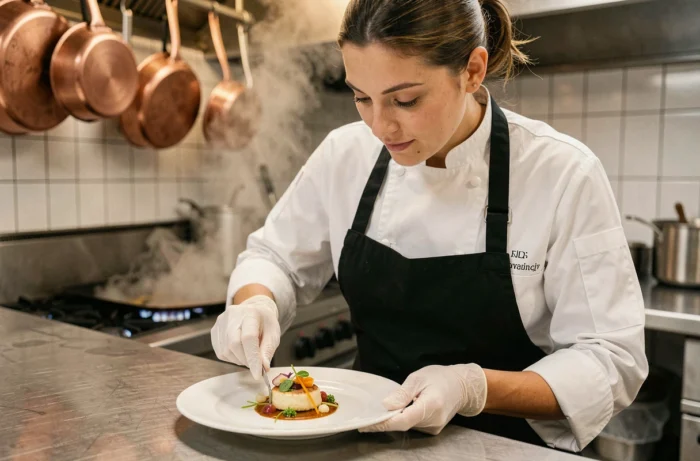
A lunchtime service that goes off the rails due to a missing gastro bin, a team understaffed on weekends, a hygiene inspection that arrives unannounced: one cannot succeed in the hospitality industry with motivation alone. The daily reality of this sector relies on precise operational skills, recent regulatory obligations, and the ability to anticipate problems before they arise in the dining room or kitchen.
Recent regulatory obligations in catering: what has changed since 2023
Before discussing jobs or training, we must address a topic that many new operators discover too late. Several regulations that have come into effect in recent years are significantly altering the organization of an establishment.
Since January 1, 2023, establishments that can accommodate at least 20 people must use reusable tableware for on-site meals. This does not just mean buying plates: it requires organizing collection, washing, storage, and tracking losses. A restaurateur who opens without planning this logistical circuit quickly finds themselves overwhelmed.
Another constraint: since January 1, 2024, all professionals must sort their organic waste at the source, with no tonnage threshold. A small neighborhood restaurant is just as affected as a corporate cafeteria. Practically, this means planning for a dedicated bin, a separate collection service, or an on-site composting solution.
In school catering and establishments hosting young children, plastic containers for cooking, reheating, and serving have been banned since 2025. For those developing a takeout offer, the rules regarding containers also apply. You can find all articles on Personnel Extra to delve deeper into these practical topics related to the daily operation of an establishment.

On-the-ground skills in hospitality: beyond culinary know-how
Catering is often associated with cooking. Technical skill matters, but it is only part of the job. A line cook who cannot manage their orders or communicate with the dining room slows down the entire chain.
Flow management and anticipation
In the kitchen as well as at hotel reception, the skill that separates a reliable professional from a beginner is anticipation. Knowing that the stock of napkins is running low before the weekend, that the cold room needs to be checked before the Friday rush, that the schedule for the following week should be prepared on Wednesday, not Sunday evening.
Organizational rigor prevents more crises than individual talent. A head waiter who has not checked their reservations in the morning will manage table conflicts in the evening. A receptionist who has not anticipated a group check-out will create a queue in the lobby.
Communication between roles
Establishments where the kitchen and dining room do not communicate waste time, spoil dishes, and exhaust staff. Operational communication between roles is one of the skills to be developed from the start of training:
- Announcing actual preparation times to the dining room to avoid making impossible promises to customers
- Immediately reporting product shortages to adapt the dining room’s messaging and avoid taking impossible orders
- Relaying customer feedback to the kitchen on the same day, not in a monthly meeting
Training in hospitality and catering: choosing a path suited to the field
The sector offers dozens of training programs, from CAP to specialized master’s degrees. Not all are equal in terms of real-world preparation. There is often a gap between what is learned in school and what happens during a first service in a brasserie on a Saturday night.
The most effective programs combine a theoretical foundation (HACCP hygiene, basic management, culinary techniques) with a long immersion in a company. A few weeks of internship is not enough to understand the constraints of continuous service. Alternating training, when possible, remains the format that produces the most operational profiles upon hiring.
What training does not always teach
Several skills that make a difference in daily operations are rarely covered in classes:
- Conflict management in a pressured team, when a cook breaks down during service and roles need to be redistributed in minutes
- Monitoring evolving regulatory obligations (organic waste, reusable tableware, plastic bans), which requires regular vigilance
- Relationships with local suppliers and price negotiation, often delegated to the chef without prior training
- Rapid adaptation to digital tools for booking, stock management, or staff scheduling

High-demand jobs in the hotel sector: where the positions are
The hospitality industry is one of the sectors struggling the most to recruit in France. This tension does not affect all positions equally. Cooks, experienced servers, and bilingual receptionists are among the most sought-after profiles.
The recruitment difficulty has several causes, but one of the most concrete remains the gap between the conditions offered and the expectations of candidates. Split shifts, weekend work, modest starting pay: establishments that struggle to recruit are often those that have not revised their work organization.
The structures that fare best are those that offer predictable schedules, two consecutive days off, and a clear internal advancement policy. A kitchen assistant who knows they can become a line cook in two years in the same establishment has a reason to stay.
The hotel sector also recruits for less visible but equally strategic roles: housekeeper, maintenance manager, revenue management manager. These jobs require specific, often technical skills, and offer stable career prospects for those who do not want to work in the kitchen or dining room.
Succeeding in hospitality and catering means accepting a physically demanding job with strict hours, but where progression can be rapid for those who master both technical skills and regulatory constraints. Establishments that properly train their teams and comply with new obligations retain their staff longer, and this is reflected in the quality of service.